
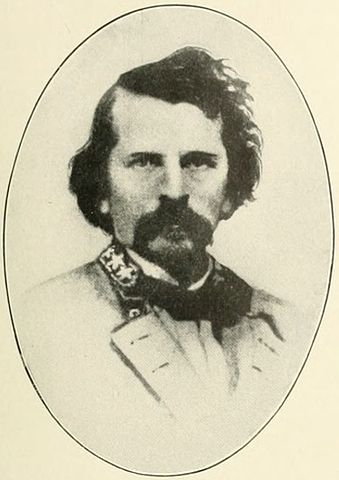
Let’s talk hats:

I confess: I’m a hat snob. Not in the traditional sense, mind you, but rather, when I’m watching a historical movie I judge the hats worn by the characters, and consequently judge the believability of the character by their hats. I loved the show Hell on Wheels, but that awful green wool Orvis-looking thing in the third season that Bohannan wore? Yikes. This predilection especially irks me in movies set in the 19th century as there is a plethora of photographs, tintypes, sketches, etc from which to deduce what types of hats people wore. Yet, many movies (and some reenactors) seem to get it dead wrong.
 Mr. Selleck is always right at home in a western, but his Quigley hat is out of place in 1860s Australia (or Wyoming).
Before I get too “high-and-mighty”, let me confess that I’ve been guilty of the “nice hat” syndrome plenty of times. I still try to maintain my current hats in good condition, and even though I wear a hat daily, they don’t get the same use and abuse that 19th century hats endured. Consequently, those floppy, stomped-on, stained and ratty hats you see in old photos sometimes bear more resemblance to my old wool felt wore-out hat blank from my rendezvous days than my current “historical” hats. My bona fides declared, here’s what I believe is important to know about 19th century hats and bringing that look to bear in the 21st century, be it in film, YouTube, television, reenactments or cowboy action shooting.
Historically speaking, hats were both a tool and a status symbol. In the “old days” folks travelled in the open climate and a hat protected from the elements, providing warmth when cold, shade when sunny and keeping off the rain. Even in carriages, men often wore their hats. It was practical and expected; in fact, it was socially expected for a gentlemen to go out and about with his head covered (a jacket or waistcoat was expected as well, but that’s a topic for another day). As far as showcasing one’s status, the rules that applied back then are the same today: folks of greater means can afford nicer things. So, if you were a banker, you may have a nicer hat than, say, the common farm laborer. Regardless, both men wore hats on a daily basis, and even the banker’s nice fancy hat would eventually develop a worn look. So, the fancy derby hat may become worn and beat-up, or the farmer who spent his money on a nice bowler to wear at Sunday/go-to-meeting events may wear it until it’s about ready to fall apart. On the flip side, wealthy ranchers like the Marquis de Mores may have had a “working hat” similar to the Boss of the Plains his hands wore, but the Marquis rarely looked shabby, as he could afford to buy replacements as needed.
John Jarrette of Quantrill’s Guerrillas displays a typical 1860s hat that was common up until the end of the century. 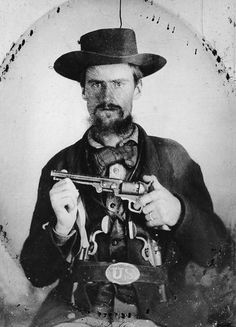
Hollywood hasn’t helped our mental image of the hat in the Old West. In fact, in the early days of the western, a big hat with a unique crease helped to distinguish a cowboy (Tom Mix ring a bell?) or give a unique style (e.g. Roy Roger’s crease) to a specific hero. While there are some photos showing an extra-big hat on a working cowboy in the style of Tom Mix, it was not as common nor as early as most of us portray. That being said, movies are more concerned with a certain look and feel than with telling it how it was. A well-worn beat-up looking hat (like those at the top of this article) may look right on a certain character in a movie, but most producers and directors don’t want their star to look like a slob. So, what do we get in our shows? We get “traditional” styles that have pretty much no parallels to the authentic/real thing.


The real Billy the Kid, and two Hollywood versions. I’d argue the hat makes a big difference in believability. Well done, Val and Gore!
Case in point: the wool felt, wire-brimmed atrocities that are being worn in the new “The West” series on Netlix. Jesse James and Billy the Kid are wearing what appear to be Australian drover-style hats, while the “bit players” have frumpy, well-worn chapeaus. Note the above picture of the real Kid. That sugarloaf, small-brimmed sombrero looks pretty rough. Still, it’s not what most directors want to see, so it’s not shown on the screen. The result is our sense of what “looks right” is affected. A few shows try to get it right: “Deadwood”, “Tombstone”, “Appaloosa” and “The Assassination of Jesse James by the Coward Robert Ford” all made excellent strides in historical accuracy of hats, and as such, the characters were much more convincing and believable.
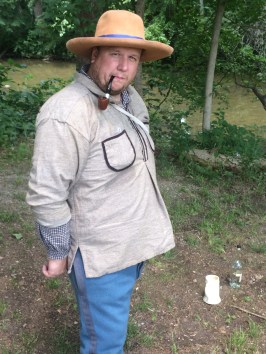 A few more campaigns and this hat will really start to take on a look of the originals!
For reenactors and shooters, all this leads to infinitely more choices (and maybe confusion). Some folks want to nail the look of the real Old West versus the “reel” Old West and as such, they buy what resembles the hats we see in old photos. Some folks want to emulate their Silver Screen heroes, and thus buy accordingly. Lots of folks fall somewhere in between. Naturally, the desire for historical authenticity is a personal journey, and some folks don’t really care. For those who do care, however, there are options for acquiring a hat that looks authentic. Online retailers like River Junction Trade Company or Clearwater Hat Company have options that will work for most all time periods, but their prices may be a deterrent. Large merchandising retailers such as Wild West Mercantile or Texas Jack’s have fairly decent options as well, but the quality of the felt and authentic detailing can be less than ideal, though the price is usually lower. If money is no object, companies like Knudsen Hat Company or Staker Custom Hats can make you something that looks dead-nuts on the money, but it will cost several hundred dollars and you’ll have to wait a bit.
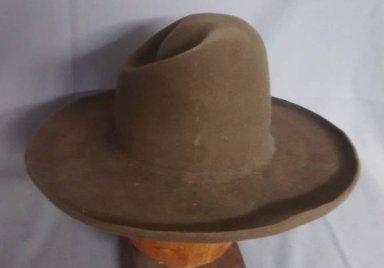 Here’s a hat that will work anytime, anywhere in rural America from 1860-1910s. (From Hats by Grizz)
Most reenactors are on a budget (myself included) and as such, we make do with what we can. One company about which I’ve heard good things (though I’ve never used them) is Hats by Grizz. This company is run by an Old West reenactor, and they advertise that they use the old-time techniques to make their hats. The pictures look good, and the reviews suggest people like the product. Someday, I may have investigate. Another option I’ve used in the past is eBay. I’ve picked up a couple very nice, high beaver content hats on eBay, steamed the hell out of them, and re-blocked/re-shaped them to a more period look. Now, this takes some time and patience, you need to have the equipment and unless you replace the sweatband it will still say “Stetson” or “Serratelli”, but it’s a great way to get a high quality felt that looks right for a fraction of the cost of a custom job.
A SASS shooter cuts loose with a scattergun while wearing a darn fine hat! 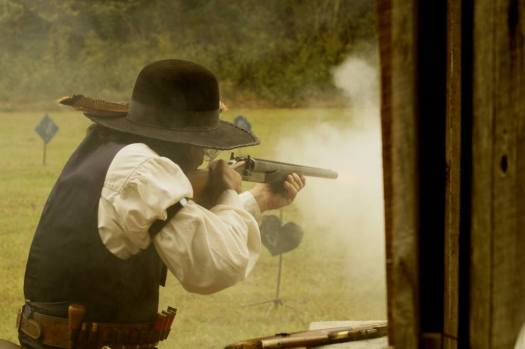
Ultimately, hat choice all comes down to what you want to see, how you see your historical self and whether or not you even care. SASS and NCOWS both are very lax with their hat restrictions, and numerous folks wear things that never were (as far as we can tell) in the historical period. Serious Civil War reenactors may be a little better, but odd choices still abound. Hollywood’s interest in historical accuracy is even lower – even in the so-called “documentaries”. Personally, I don’t care what someone chooses to wear to a shoot or a reenactment, but I do care what I wear. If I’m portraying a character, I want my attire to accurately reflect the who, where, when, why and how. The only way to nail that is to study old photos and see what was worn and how it was worn.
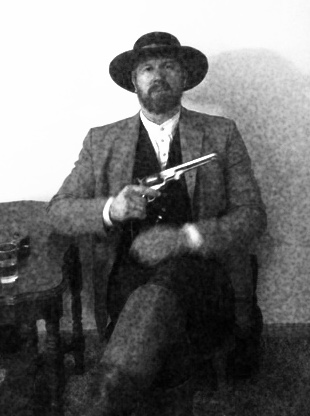 Sack coat, plain shirt, low-crown kettle-curled black hat and a Colt Navy. Not dramatic, but all common and documentable to the 1860s.
A hat was such an indispensible item of men’s clothing in the 19th century that it becomes a part of the portrayal and the character. For those who know the details and study old photographs, the wrong hat can ruin an otherwise excellent impression, while the right hat can sell it. Decide what you want to do with your portrayal and what your interests are, but do so with your eyes wide open. If someone wants the Bohannan special from Season Three that’s fine, but I would hate to spend my money on something that’s wrong simply because I don’t know the difference. When it comes to forking over large amounts of cash, ignorance is seldom bliss. Like Davey Crockett once said, “Be always sure you’re right – then go ahead.”
Keep your powder dry, your nose in the wind, and your eyes along the skyline.
Wild Ben
 Open Top Productions